

Hiring a remodeling contractor can feel like the most uncertain part of planning a kitchen or bathroom remodel. You may be comparing bids with very different prices, wondering if the project will be on budget and on-time, or worrying that important details will be missed once construction begins.
The best way to vet a remodeling contractor is to look beyond personality and price. Verify the company’s credentials, understand who will manage each part of the project, compare detailed scopes of work, and speak with recent clients about communication and problem-solving.
Whether your home is in Carlsbad, Encinitas, Oceanside, Solana Beach, or another North County community, the following process will help you make a more informed decision.
Download the free 14-page homeowners guide
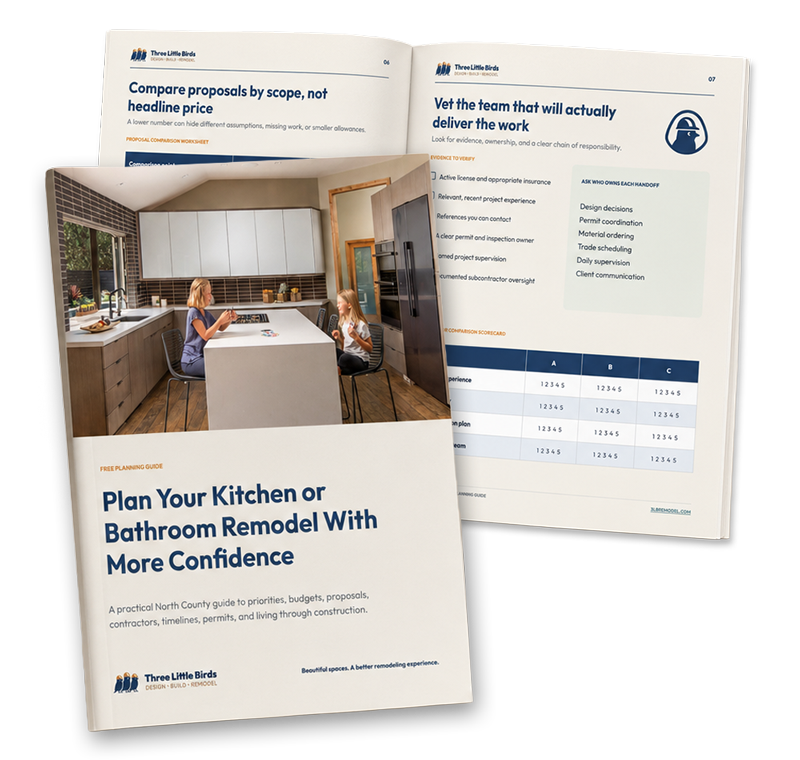
A free practical guide to setting priorities, building a realistic budget, comparing contractors, understanding the timeline, preparing for construction, and completing the project on time.
1. Verify the Contractor’s License, Insurance, and Experience
Start with the basic facts before discussing finishes or signing a contract.
California homeowners can look up a contractor by license number, business name, or individual name through the Contractors State License Board license-check tool. Confirm that the license is active and that the business name matches the company presenting the proposal.
The Contractors State License Board also recommends checking recent references and similar completed projects. Its consumer guidance advises homeowners to obtain at least three bids before choosing a contractor.
What documents should a remodeling contractor provide?
Ask each contractor for:
- Their California contractor license number
- Proof of general liability insurance
- Workers’ compensation information, when the company has employees
- A written proposal or scope of work
- A proposed payment schedule
- Recent references for comparable projects
- Information about warranties or workmanship guarantees
- An explanation of who will obtain required permits
Experience should also match your project. A contractor who primarily handles exterior repairs may not be the right fit for an interior remodel requiring cabinetry, plumbing, electrical work, tile, lighting, and detailed finish coordination.
2. Ask Who Will Manage Every Part of the Remodel
A kitchen or bathroom remodel involves much more than the days when workers are physically inside your home. Someone must coordinate design, selections, permits, purchasing, scheduling, subcontractors, inspections, and communication.
Ask each contractor to explain who will be responsible for:
- Developing or finalizing the design
- Producing drawings and specifications
- Confirming finish and fixture selections
- Checking product availability and lead times
- Preparing permit documents
- Communicating with the appropriate local building department
- Scheduling subcontractors and inspections
- Managing the jobsite
- Documenting changes or unexpected conditions
- Providing progress updates to you
North County homes vary considerably in age, layout, condition, and jurisdiction. The person evaluating your project should be able to explain how the team will investigate existing conditions and determine any permitting requirements.
Pay attention to how clearly the contractor answers these questions. If responsibilities are vague before the contract is signed, they are unlikely to become clearer once several trades and deadlines are involved.
A coordinated design-build process can reduce the number of handoffs between separate designers, contractors, and vendors. Learn more about the Three Little Birds remodeling process.
3. Compare the Detail in Each Proposal, Not Just the Price
Two remodeling bids are only comparable if they describe the same work.
One proposal might include demolition, disposal, permit coordination, finish installation, and site protection. Another may leave several of those items out, making its initial price look lower even though the homeowner will still need to pay for them later.
A useful proposal should clarify:
- The rooms and areas included in the project
- The work that will be completed
- Materials or products included in the price
- Allowances for items not yet selected
- Items supplied directly by the homeowner
- Permit fees and design services
- Cleanup and debris removal
- Known exclusions
- The process for approving additional work
- Payment milestones
- Estimated construction sequencing
Look carefully at allowances
An allowance is a placeholder amount for something that has not been selected or fully priced. Allowances are common, but they should be realistic and easy to understand.
For example, a proposal may include an allowance for tile, plumbing fixtures, or cabinet hardware. Ask whether the allowance covers only the product or also includes shipping, tax, preparation, and installation.
If one bid contains much lower allowances than another, the final cost may rise once you begin making selections. Ask the contractor to walk you through each allowance before treating the proposal as a fixed project budget.
Ask what is specifically excluded
Exclusions help show where the contractor’s responsibility ends. Common questions include:
- Are appliances included?
- Who moves or stores furniture?
- Is painting included?
- Are structural repairs included if damage is discovered?
- Who pays for additional permit corrections?
- Is temporary kitchen or bathroom access addressed?
- Does the price include final cleaning?
A detailed proposal does not eliminate every possible surprise. It does give you a much clearer way to understand how discoveries and changes will be handled.
4. Check References With Specific Questions
References are most useful when you ask more than, “Were you happy with the result?”
Request recent clients whose projects were similar to yours in size and complexity. A beautiful portfolio shows what a contractor can build, but a past client can help you understand what it was like to live through the process.
Ask references:
- Did the team communicate consistently?
- Did you know who to contact when you had a question?
- Were the proposal and payment schedule easy to understand?
- How were changes documented and priced?
- Did the team explain delays or unexpected discoveries?
- Was the jobsite treated respectfully?
- Did the contractor follow through on the final correction list?
- Would you hire the company again?
- What do you wish you had known before starting?
Listen for specific examples rather than general praise. A remodel does not need to be completely free of complications to be successful. What matters is whether the contractor communicated clearly, documented decisions, and took responsibility for resolving problems.
5. Use a Simple Contractor Scorecard
It is easy to choose the person you liked most during the first meeting. A good working relationship matters, but personality should be considered alongside documentation, relevant experience, and process clarity.
Score each contractor from one to five in these areas:
- Verified license and insurance
- Experience with similar remodels
- Quality of completed work
- Proposal detail
- Realistic allowances
- Clear exclusions
- Communication during the interview process
- Project-management structure
- Reference feedback
- Change-order process
- Overall confidence and fit
Watch for warning signs such as pressure to sign immediately, vague answers, missing scope, unusually large upfront payments, or a price that is dramatically below every other bid without a clear explanation.
For California home improvement contracts, the Contractors State License Board states that the down payment generally cannot exceed 10 percent of the contract price or $1,000, whichever is less. Review the current California consumer guidance for hiring a contractor before signing.
Frequently Asked Questions
How many contractor bids should I get?
The California Contractors State License Board recommends getting at least three bids. This gives you enough information to identify major differences in price, scope, allowances, and approach.
The goal is not automatically to choose the middle bid. It is to understand why the bids differ and which contractor has accounted for the complete project most clearly.
What should I ask a contractor’s past clients?
Ask about communication, change orders, schedule updates, cleanliness, problem-solving, and follow-through. You should also ask whether the final cost aligned with the approved scope and whether the client would hire the contractor again.
Is the lowest remodeling bid usually the best value?
Not necessarily. A lower bid may reflect an efficient process, but it can also omit design work, permit coordination, installation labor, cleanup, or realistic material allowances.
Ask each contractor to explain what is included and excluded. The best value is usually the proposal that gives you the clearest understanding of what you are purchasing and how the work will be managed.
Bring Your Questions to a No-Pressure Consultation
You do not need to understand every construction term before speaking with a remodeling team. You should, however, leave the conversation with a clear understanding of the next steps, responsibilities, and information needed to make a decision.
Three Little Birds helps North County San Diego homeowners plan and complete kitchens, bathrooms, accessory dwelling units, and interior remodeling projects through one coordinated design-build team.
Schedule a no-pressure consultation and bring us your project questions, early ideas, or contractor comparison list. We will help you understand what your remodel requires and what a well-planned path forward can look like.